This is a transcription of Denmark: Gettin’ Hygge With It
David: Hello. Welcome to Strong Sense of Place.
Melissa: In each episode, we focus on one destination and discuss what makes it different than any other place on Earth.
David: Then we recommend five books we love that took us there on the page.
Melissa: I’m Melissa Joulwan.
David: I’m David Humphreys.
David: We’re going around the world one great read at a time. Thanks for joining us.
[cheerful music]
David: Welcome to Strong Sense of Place. Today we get curious about Denmark. You’re going to find out you’ve been carrying a piece of Denmark around in your pocket for years. Then we’ll talk about five books we love.
Melissa: I’m recommending a slim novel about Denmark’s witch trials. It’s one of the weirdest books I’ve read for this show, and I would happily pick it up right now to read again. The language is so arresting, I highlighted almost the entire book.
David: I’ve got a multi-generational family saga that walks the tightrope between delightful and tragic. Plus we’ll talk about why Danes are so freakin’ happy. But first, Mel’s going to bring us up to speed with the Denmark 101.
[cheerful music]
Melissa: Let’s get oriented! Denmark is just north of Germany. It sits between the North Sea and the Baltic Sea. Sweden is directly to the northeast. Malmo, Sweden and Denmark’s capital of Copehagne are connected by the Øresund Bridge over the Strait of the same name.
Melissa: Denmark is made of more than 400 islands plus Greenland, the Jutland (yoot-lan) Peninsula, and the Faroe Islands — which are a 40-hour ferry ride away in the far North Atlantic. Denmark is super flat, and no part of the country is more than 30 miles from the sea. The two primary islands of Denmark are Zealand — that’s where you’ll find Copenhagen — and Funen. That’s where Hans Christian Andersen was born. More on him later.
Melissa: Every blog post, travel guide, and video I consumed to learn about Denmark described it as very laid-back and chill. Denmark routinely ranks in the top five happiest nations in the world.
Melissa: This year, it’s #3 after Iceland and Finland. It does seem quite idyllic. It’s all sparkly and fresh: water, sky, land — flat, vast, and bright with wildflower fields, colorful boats ferrying among the islands, cozy little lego houses with grass roofs, and bicycles. So many bicycles!
Melissa: The first bike lane in Denmark was built in 1892 along the esplanade in Copenhagen. Today, there are more than 744,000 bicycles in the city. That’s five times more bikes than cars.
David: veYeah — and one reason that ratio is so lopsided is that cars in Denmark cost about three times what they cost everywhere else. Personally, I’m fine with that. We’ll talk more about Danish taxes in a bit.
Melissa: Denmark roughly the size of the US state of Maryland, which makes it the smallest Scandinavian country. But it’s mighty! In the 10th century, Denmark’s Vikings were out there doing Viking stuff. And in the 14th through 16th centuries, Denmark ruled all of Norway and part of Sweden. In 1523, Sweden broke away, but it wasn’t all bad because Denmark eventually got a glow-up. From 1800 to about 1850, Denmark was in its Golden Age, creatively speaking. Copenhagen was kind of a mess: there were fires, bombardment by British forces during the Napoleonic Wars, and a national bankruptcy. But! But! Bad times breed good art. The Danes embraced Romanticism and created world-class architecture, landscape painting, sculpture, ballet, science, and literature.
Melissa: Which brings us to Hans Christian Andersen. He’s known as HC in Denmark, so that’s what I’ll call him, too.
Melissa: HC was born in April 1805 in the city of Odense. You probably know him as the author of fairy tales including ‘The Little Mermaid,’ ‘The Princess and the Pea’ ‘The Ugly Duckling,’ and one that seems depressingly apt these days: ‘The Emperor’s New Clothes.’
David: Yeah, that one’s having a moment.
Melissa: HC was internationally respected during his lifetime. The Danish government paid him an annual stipend for being a national treasure. If you visit Odense, you can explore a museum dedicated to him and visit his childhood home. There are also several lovely HC sites in Copenhagen. You can pay your respects at his grave in Assistens Cemetery, which is one of those pretty cemeteries that’s really a city park in disguise.
Melissa: There’s a statue of The Little Mermaid sitting atop a rock on the Langelinie Promenade, a tidy little park on the waterside. And Tivoli Gardens, a 19th-century amusement park and garden. The second oldest amusement park in the world. It was Walt Disney’s inspiration for his magical parks, and it inspired HC’s story ‘The Nightingale.’ The Emperor’s palace in the story is based on the real-life Chinese Pavilion in Tivoli. If you take a seat on the amusement ride ‘The Flying Trunk,’ it will float you past 32 different scenes from HC’s fairy tales. It’s a Danish cousin to Disney’s It’s a Small World ride.
Melissa: There are two libraries worth visiting in Copenhagen. First up is the Old University Library on Fiolstræde. The name means Violet Alley, and it’s a pedestrian street in the city’s old town. It was historically known for its used bookstores, and you can still find some good ones there. The library was founded in 1482 — but the current building was established in 1861. And it’s a Neo-Gothic beauty. The central hall soars into the air and is supported by cast-iron arches. A balcony circles the second floor, and the whole shebang is filled with floor-to-ceiling bookshelves, frescoes, and library ladders. It’s basically a books cathedral.
Melissa: The other library you won’t want to miss is the Royal Danish Library, also known as the Black Diamond. It’s a combination of an old redbrick library — built in 1906 — and a modern hunk of shiny, polished black granite and glass that sits right on the edge of the harbor. The two are connected by bridges across an eight-story atrium with a glass front wall. From every spot inside, you can see sparkling water and endless sky.
Melissa: There’s also the Old Reading Room, which is like stepping into a turn-of-the-century gentlemen’s library — dark wood, marble columns, green-shaded reading lights. The rare books on display include a Gutenberg Bible, Tycho Brahe’s original astronomical notes, and Beethoven’s manuscript of the Solemn Mass.
Melissa: Outside, you’ll definitely want to meander in the gardens behind the library. There are mature leafy trees, formal flowerbeds, a pond, and a statue of the existential philosopher Kierkegaard. There’s also a café with views of the harbor — and they make box lunches to go so you can picnic outside.
Melissa: Which is a great segue to both outdoor activities and Danish food. What do you want to hear about first?
David: Stuff to do outside!
Melissa: Denmark is a fantastic place to ride bikes. Flat as a pancake, with great trails everywhere. Coastal trails take you past lighthouses and dramatic cliffs. In the northeast, you can ride along sand dunes and watch birds of prey soar overhead. There’s even a panoramic forest route through Scandinavia’s first Dark Sky Park — it’s beginner-friendly, so anyone can do it.
Melissa: There’s also so much great hiking. The trail that grabbed me is called The Kanino, and takes you on a walk all the way around an island of wild rabbits. In a country made of islands, getting out ON or IN the water is an everyday occurrence. You can take pleasure cruises, go kayaking, or head out on a oyster safari! In the mud flats of the Wadden Sea on the Jutland (yoot-lan) Peninsula, you tromp around in wellies, pluck oysters from the seabed, then roast them over a bonfire on the beach. I don’t even like oysters, and I want to do that!
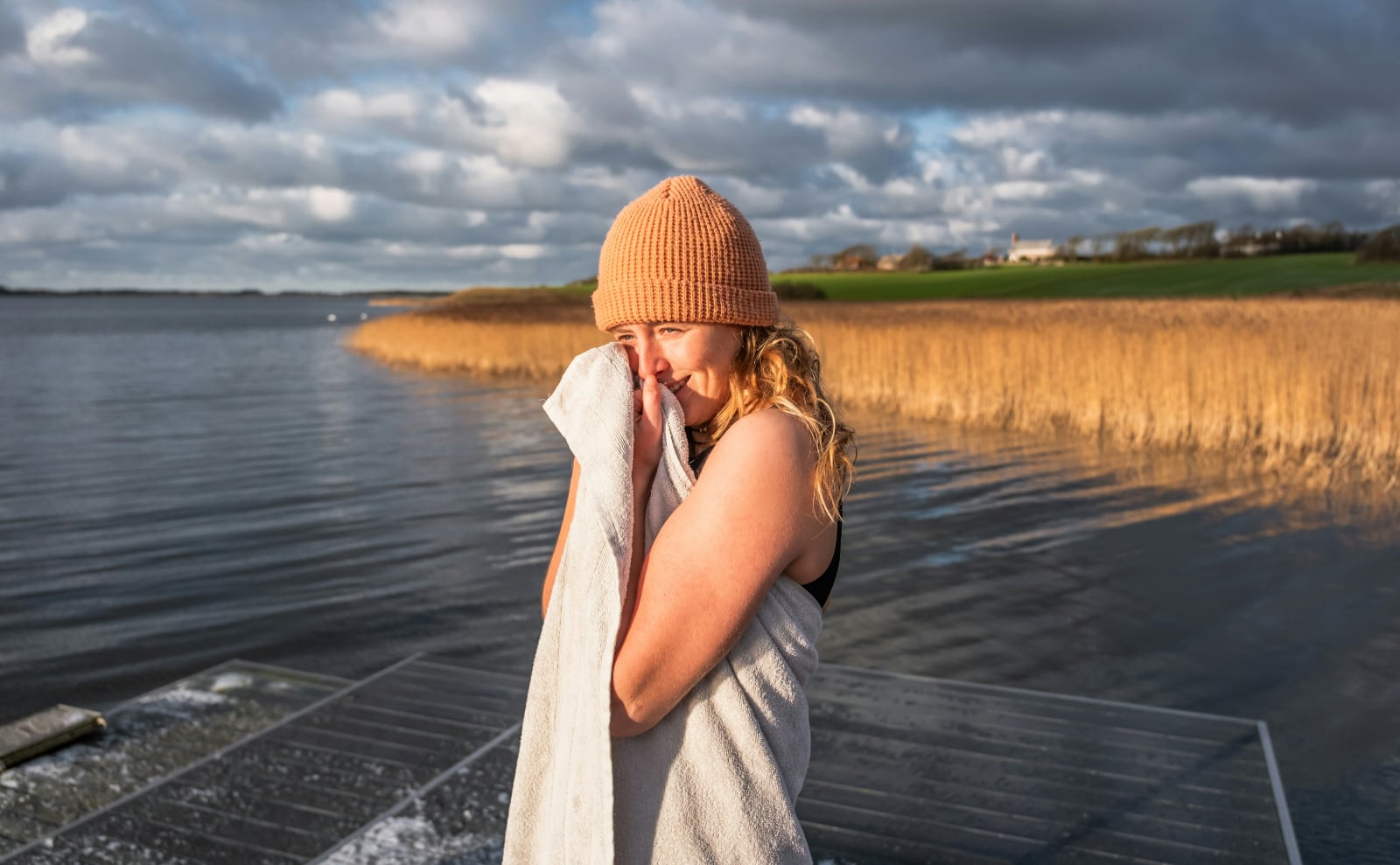
Melissa: Another thing that calls to me like a sea siren? Wild swimming. There are beaches all over Denmark. Copenhagen’s harbor is so clean, it’s one of the few world capitals where you can take a dip right in the city center. There are a bunch of harbor baths with boardwalks, buoys, diving boards, and lifeguards.
Melissa: Which brings me to food. And that is not the non sequitur you might think it is. To prepare for this episode, I read the book ‘Eat Copenhagen’ by Trine Hahnemann. It’s a mashup of cookbook, food memoir, and travel guide. The author is a Copenhagen native who’s lived in almost every neighborhood. Her book takes you to one ‘hood at a time with tips on what and where to eat, along with her childhood recollections, and recipes in cases you can’t get there in person. Her advice often includes coffee, a pastry, and a dunk on the water. She writes, ‘In Nordhavnen, get a coffee at Original Coffee, or a pastry and a sourdough bread at Andersen & Maillard… take your coffee and pastry, hang out on the public wooden decks and take a swim in the refreshing water.’
Melissa: I’ve come to a conclusion about traditional Danish food: Danish people eat like bears. Danish cuisine focuses on basic ingredients: meat — especially pork — potatoes, berries, things from the sea like oysters, pickled herring… and then: pastries! Lots of pastries! There is a dazzling array of confections made from buttery pastry, marzipan, almonds, cinnamon, and fruit. Plus, meaty dark rye bread, and open-faced sandwiches called Smørrebrød — bread topped with potato salad, shrimp salad, smoked salmon, liver paté, or roast beef.
Melissa: The national dish is fried pork belly with boiled potatoes in a creamy parsley sauce. There’s also roast pork with potatoes, breaded pork and veal patties, Danish meatballs, and a bacon-onion sauce with mashed potatoes whose name I won’t try to pronounce in Danish, but it English, it’s called ‘burning love.’
Melissa: Now we must talk about hot dogs. Danish hot dogs are a Thing. They’re made from pork and are bright red in color — like, flaming hot Cheetos red. The proper way to order it is with everything, which means ketchup, spicy Danish mustard, pickled cucumbers, chopped raw onions, crispy fried onions, and Danish remoulade. That’s a sauce made with mayo, chopped pickles, capers, and a smidge of curry power. Eating a hot dog with mayo in Norway changed my life, and I feel a near overpowering lust for a Danish hot dog right now.
Melissa: I should also mention that Copenhagen is ground zero for New Nordic Cuisine. Creative restaurants like Noma, Alchemist, and Geranium use hyper local and seasonal ingredients for meals that are both theater and sustenance. It’s art and science.
David: Wanna share some examples?
Melissa: Beef tartare with ants, deep-fried reindeer moss, fermented sea kelp, sea buckthorn. I have no doubt eating at one of these restaurants is a once-in-a-lifetime experience. But the peasant in me is really excited about the hot dog.
Melissa: I’ll put lots of links in the show notes for the best hot dog stands, the reservation links for New Nordic restaurants, maps of where to go swimming, the bunny island hiking route, and much more in show notes.
Melissa: My final fun facts that didn’t fit anywhere else. One: Kronborg Castle, Helsingør (Elsinore), is famous as the setting of Shakespeare’s Hamlet. And Two: Two out of three Danes have a last name ending in -sen, and 4% are named Hansen.
Melissa: That’s the Denmark 101.
David: I’m about to say three statements. Two are true. Mel doesn’t know which is the lie. Statement one: Danishes aren’t Danish. Statement two: USB, the standard for data transmission and power delivery, is a three-letter Danish acronym. Statement three: A Danish man once released himself from being buried alive in an Arctic blizzard by carving his way out with a tool made from his own frozen poop.
David: Let’s take them one at at time. Danishes aren’t Danish. That is true. In Copenhagen, they don’t call it a Danish. They call it a wienerbrød, which translates very literally to Vienna bread. If you go to Vienna though, they don’t call it a Danish either. They call it a Kopenhagener — Copenhagen pastry. The Danes give the credit to the Austrians, the Austrians give the credit back to the Danes, and the rest of us — almost everyone outside Denmark and Austria — just call it a Danish and get on with our morning.
David: One of the most popular pastries in the world is somebody else’s invention, depending on who you ask. So how did we get here? The story starts in 1849. In June of that year, Denmark — which had been an absolute monarchy for nearly two hundred years — got its first constitution. Among other things, it gave Danes the right to walk off the job. A year later, that’s exactly what the bakers of Copenhagen did.
David: The story goes that in 1850, Copenhagen’s journeymen bakers walked off the job. Up until then, bakers across Europe got paid in room and board: you lived in the master’s attic, ate at his table, worked the eighteen-hour overnight shift, and couldn’t leave. Most shops required journeymen to be unmarried so they could be housed on the premises. So they weren’t striking for a raise. They were striking to be paid in money. Cash wages meant you could rent a room. Get married. Save money. Quit. The strike was about whether the brand-new Danish constitution applied to the people who baked the morning bread.
David: The bakery owners, faced with an empty workforce, did what many employers do: they hired scabs. From abroad. A lot of those replacements came from Vienna. At the time they had the most sophisticated baking tradition in Europe, including a technique the Danes hadn’t really used: laminated yeast dough. You take a yeasted bread dough, fold cold butter into it in thin sheets, chill it, fold it again, and again, and again, until you’ve built up dozens of layers of butter and dough that puff up into something light and crisp and very rich when it hits the oven. The Viennese had been baking that way for at least a generation. They brought it to Denmark.
David: The strike ended. The Danish bakers came back. And they found that Copenhagen had developed an appetite for the Viennese stuff. So they learned to make it. They added more butter. More egg. They filled it with remonce — equal parts butter and sugar creamed together — and with marzipan, and custard, sometimes nuts and spices. They made it sweeter and richer than the Viennese original. And they gave the result a name that pointed back across the map, to the city it had come from.
David: That’s why the Danes call it Vienna bread. The Austrians, watching the Danes turn their export into something that was maybe better than the original, returned the favor: they call the Danish version Kopenhagener Plunder — or, literally, loot from Copenhagen. It finally caught the name ‘Danish’ when one of the Danes brought the baking technique to the US in the early 1900s. As in, ‘That Danish guy makes some yummy stuff.’
David: USB, the standard for data transmission and power delivery, is a three-letter Danish acronym. The USB on your cables stands for a Danish phrase — universel serieforbindelse — coined by a Copenhagen engineer. I made that one up!
David: USB stands for ‘Universal Serial Bus’ — three perfectly English words. It was created in the mid-1990s by an engineer named Ajay Bhatt at Intel, in Oregon. He got tired of his wife calling him at work to say she couldn’t print their daughter’s homework.
David: There is, though, a technology that you know that was named for a Dane. And the story behind that is better than anything I could make up. In December of 1996, three giant tech companies — Intel, Ericsson, and Nokia — sat down together to design a new short-range wireless standard. They needed a code name for the project. So they could stop saying, “you know, this thing we’re doing.”
David: An Intel engineer named Jim Kardach had been reading a book about Vikings, and a Swedish colleague at Ericsson had been telling him about a 10th-century king of Denmark named Harald Gormsson. Better known as Harald Blåtand. Blåtand translates, very directly, to blue tooth. There are two theories. First: Harald had a dead front tooth, gone grey or black. Second: he really liked blueberries. Either way, he became known as Bluetooth.
David: Harald Bluetooth ruled Denmark in the mid-900s. He is the king who united the warring tribes of Denmark into a single kingdom, and then conquered Norway for extra credit. Kardach was reading about all of this in the middle of the meeting where engineers were fighting about what to call this thing. King Harald united warring kingdoms. We are trying to unite — well, basically the same thing. What if we just called it Bluetooth?
David: He said it out loud. As a placeholder. As an obvious-this-will-be-replaced-by-marketing joke. The marketing team came back with their official names. None of them stuck. Bluetooth went into contracts, into engineering documents, into developers’ speech. By the time anyone tried to change it, it was already a thousand-year-old Danish king’s nickname locked into the protocol that connects your headphones to your phone.
David: But the best part of the story is the logo. You’ve seen it. It’s that angular blue symbol that looks vaguely like a stylized letter B, or possibly a hieroglyph. It looks like a modern design — an abstract mark that means Bluetooththe way the Wi-Fi symbol means wireless.
David: That symbol is a thousand years old. It’s a bind rune — a single character formed by merging two runes. In this case, two runes from the Younger Futhark, the Viking alphabet. The first rune is Hagall, which makes the H sound — that’s the half-asterisk part down the middle. The second rune is Bjarkan, which makes the B sound — that’s the B-shape wrapped around it. Stack them together. You get H + B. King Harald Bluetooth’s initials. The end result: you have been carrying around a dead Viking’s monogram for years. And I think we’re all better for it.
David: There was a Danish man who once released himself from being buried alive in an Arctic blizzard by carving his way out with a tool made from his own frozen poop.
David: In 1923, deep in the Canadian Arctic, a thirty-seven-year-old Danish explorer named Peter Freuchen was buried alive. He’d separated from his group when a blizzard caught him. He’d flipped his dogsled upside down to make a shelter and crawled underneath. He fell asleep. When he woke, snow had drifted over him and frozen into a solid lid. His arms were pinned. His snow knife was outside, with his other supplies. His dogs were a hundred yards away, huddled by a boulder. The shelter was no longer a shelter; it was now a coffin.
David: A few hours in, he had an idea. He’d noticed that frozen dog feces in Greenland was hard as stone. He wondered, in the dark, whether human waste would behave the same way. He decided to find out. He pooped. He made a chisel – and then chipped his way through the ice above him.
David: By then his foot was frostbitten. It would, in time, cost him the leg. But he was alive. He’d chiseled his way out of an ice coffin with his own poop. That’s not the only wild story about Freuchen.
David: He was born Lorenz Peter Elfred Freuchen in 1886, in a small town in Denmark. He grew up and went to medical school at the University of Copenhagen because he didn’t know what else to do. There he met a Copenhagen dockworker who would change his life.
David: In 1905, the hospital staff at Royal Frederiks Hospital were about to wheel a half-dead dockworker to the morgue when somebody noticed his rib cage was still barely moving. One of Freuchen’s professors performed a pioneering surgery that saved the man’s life. It took about a year for the dockworker to recover. When they were ready for him to go, there was a moving farewell speech. The whole staff watched their star patient lean on his cane on the curb outside, step out into the street — and get killed by a speeding car.
David: Freuchen took this as ‘a message from the Cosmos.’ He decided, in his own words, ‘I was not cut out to be a doctor.’
David: What pointed him toward the Arctic was a different kind of accident. He fell in with theater students planning a satirical play about a Danish polar explorer named Ludvig Mylius-Erichsen. Freuchen had already been to one of Mylius-Erichsen’s actual lectures and admired him; he thought the satire was hollow. So he tracked down the man’s home address and knocked. By the end of the conversation, Freuchen had a place on the Danmark Expedition to northeast Greenland. In his own words, he ‘said yes faster than saints pass through the gates of heaven.’
David: He spent the next fifteen years mostly above the Arctic Circle. He married an Inuk woman. He co-founded the Thule Trading Station — which was the northernmost trading post on Earth at the time. When his wife died of Spanish flu in 1921, the local church refused to bury her in the Christian graveyard because she wasn’t baptized. So he buried her himself.
David: The frostbite from the ice-tomb caught up with him in pieces. First, his toes. He did the amputation himself, with pliers and a hammer. Later he would lose the rest of the leg, fortunately in a hospital. He spent the rest of his life on a wooden leg, but he never stopped travelling.
David: He wrote over 30 books, mostly about his adventures and the Arctic.
David: In 1933, MGM made a film based on two of his books — Eskimo, also released as Mala the Magnificent. Freuchen co-wrote it, and played the villain. It won the very first Academy Award for Film Editing.
David: When the Nazis occupied Denmark in 1940, Freuchen joined the resistance and did something that has been widely mistold. He went around telling people he was Jewish. He wasn’t. His daughter confirmed that whenever anyone made an antisemitic comment in front of her father, he would declare himself Jewish, forcing the antisemite into a public standoff. He fed the rumor to American Jewish newspapers. The Jewish Daily Bulletin called him “perhaps the most unique Jew alive.” It was a sustained act of solidarity, not a fact about his birth.
David: In 1944, he was arrested for being part of a resistance plot to break wounded American POWs out of a Danish hospital. He spent three days in a Nazi prison. The popular version has him sentenced to death and pulling off a heroic escape. According to his biographer, Freuchen invented that for his American memoirs because he was embarrassed by what actually happened: his younger brother pulled some strings. He knew an MGM executive, who knew a friend of the Gestapo chief. Words were said, and Freuchen was released alongside nine other inmates.
David: After his release, he was smuggled out of Denmark hidden inside a wooden shipping crate, aboard a freighter that passed German patrol boats into Swedish waters. He eventually made his way to New York.
David: In 1956, at the age of seventy, with one leg, a huge beard, and a lifetime of stories, Peter Freuchen went on the American TV quiz show The $64,000 Question. The show was the most-watched program in the United States that year — bigger than I Love Lucy. Freuchen’s category was The Seven Seas.He won the top prize — the 64,000 dollars.
David: He had spent forty years above the Arctic Circle. He’d lost his leg to it, made his name from it, married into it. But there was one thing he’d never done: he’d never stood on the North Pole. In September of 1957, a broadcaster named Lowell Thomas finally offered to take him along on a flight to do it.
David: On the second of September, the group landed at the Elmendorf Air Force Base in Anchorage on the way north. The crowds at the base recognized Freuchen from the game show, not from anything he’d done as an explorer. He cheerfully signed autographs. They climbed the steps to the officers’ quarters.
David: At about five-thirty in the afternoon, Lowell Thomas and another explorer in the party heard a muffled thump from upstairs. They found Freuchen sprawled across the floor of his room. He had a massive coronary. He was seventy-one.
David: His ashes were scattered over Thule. The place that had made him.
David: I’ll leave the close to his biographer, Mitenbuler. He writes that in the United States, Freuchen’s obituaries ‘often said that Freuchen, winner of The $64,000 Question, also happened to be a polar explorer.’
David: He’d founded the northernmost trading post on Earth. He’d married into the Inuit. He’d carved his way out of an ice tomb with his own waste. He’d lost his leg to the Arctic, declared himself Jewish for solidarity, escaped the Nazis in a shipping crate, and been the heart of a movie that won an Academy Award. The world remembered him for going on a quiz show.
David: If you’re interested in more… 2023’s ‘Wanderlust: An Eccentric Explorer, an Epic Journey, a Lost Age’ by Reid Mitenbuler. That is two truths and a lie.
Melissa: My first recommendation is ‘Smilla’s Sense of Snow’ by Peter Høeg (Huuhr), translated from Danish by Tiina Nunnally.
Melissa: This book was first published in 1992, and I think we can call it a modern classic. It was a runaway best seller at the time — translated into 25 languages, including Indonesian, Polish, and Portuguese. The estimate is that it’s sold at least one million copies.
Melissa: Not bad for a brainy thriller that’s set in two physically and metaphorically chilly places — Copenhagen and Greenland. The story has a heartbreaking crime at its center and Smilla, a prickly heroine who is far more comfortable with mathematics and snow than she is with people.
Melissa: Smilla. Smilla is a wonder. She’s half Danish, half Inuit and spent her childhood in Greenland, though she’s now a chic, well-dressed city girl with sharp edges. She’s very sarcastic, more than a little depressed, and she chafes against authority. She is also an expert at reading snow and ice. Her life experiences — including a beloved but now-dead mother and a very wealthy, estranged father — have led her to be extremely self-contained. Introversion is her defining characteristic. She says, ‘I feel the same way about solitude as some people feel about the blessing of the church. It’s the light of grace for me. Never do I close my door behind me without being conscious that I am carrying out an act of charity towards myself.’
Melissa: But her neighbor Isaiah, a 6-year-old Inuit boy, has made significant cracks in her icy outer crust. Her solitude begins to border on loneliness. Against all reason, Smilla and Isaiah have become friends. When Isaiah is found dead from a fall off the roof, the police decide it’s an accident. But Smilla knows two things they don’t: Isaiah was terrified of heights, and his tracks in the snow tell her a secret. Isaiah didn’t just fall — he was running from someone.
Melissa: So she begins her own investigation. The clues lead her into emotionally dangerous backrooms of her own history — and the shameful colonial past between Denmark and Greenland.
Melissa: Smilla is abetted in poking around by another remarkable character. His real name is Peter, but he’s better known as The Mechanic. He’s another outsider whose contradictions resolve into a pleasing whole. Physically, he’s a giant: tall, strong, powerful. But he has dyslexia and speaks with a stutter, limitations which lead people to underestimate him. That’s both a superpower and a hindrance. He also has a set of unexpected talents — lock picking, scuba diving, cooking, and phone tapping, among others.
Melissa: Smilla and The Mechanic both play fast and loose with their lives. There are multiple scenes where they place themselves in peril. It’s absolutely thrilling.
Melissa: There are moments of great tenderness: We see Smilla’s relationship with the little boy Isaiah in flashbacks. And we watch as she and The Mechanic expose their vulnerable underbellies to each other — only to retreat when the closeness becomes too much.
Melissa: The first two times I read this book — in the ’90s and in 2019 — I enjoyed spending time with Smilla, and I was quite taken with the will-they-or-won’t-they love story between her and The Mechanic. This time, I read it through the lens of wanting to understand Denmark, and it delivered.
Melissa: The story begins in Copenhagen, where we explore the waterfront and the city’s neighborhoods with Smilla. Then the action moves to a ship crossing the north Atlantic to Greenland. That bit is deeply claustrophobic and brutally suspenseful. Then the final showdown takes place in the irresistible and inhospitable beauty of Greenland.
Melissa: The mystery Smilla is trying to solve is intrinsically bound up in Denmark’s colonial relationship with Greenland. The history of the two countries sneakily seeps into your understanding as your caught up in the brisk, breathless plot.
Melissa: In an interview on the BBC Book Club podcast, Høeg explained that the character of Smilla came to him in a dream. His main character was originally going to be a male naval officer with authority issues. But one night, Høeg dreamt of a giant polar bear pelt — he called it ice bear fur, which was just a delight — he dreamt of a polar bear pelt that covered a mountain. Walking on the fur was a small female tiger, and when he woke up, he knew his main character had to be a woman.
Melissa: It turns out, he is massively groovy. In an interview with the LA Times, friends called him ‘a fairy person’ and ‘some kind of wood elf.’ In addition to being a best-selling author, he’s also a meditation leader. He’s made a handful of videos for a channel dedicated to meditation, so you can meditate with Peter Høeg, should the spirit move you. I’ll put a link in show notes.
Melissa: If you’ve never read ‘Smilla’s Sense of Snow,’ or it’s been a while, I encourage you to pick it up. It’s the Scandi-Noir book that started it all, and it holds up. It’s an action-adventure story, a crime procedural, a travelogue, an oddball love story, and an exploration of what it’s like to be trapped between two words.
Melissa: It’s ‘Smilla’s Sense of Snow’ by Peter Høeg (Huuhr), translated by Tiina Nunnally.
David: My first book is ‘We the Drowned’ by Carsten Jensen. That book starts with this line:
Many years ago there lived a man called Laurids Madsen, who went up to Heaven and came down again, thanks to his boots.
David: The rest of the book falls out like that — this sort of fairytale storytelling over multi-generational family trauma and historical fiction.
David: It’s like hearing stories from your grandfather and wondering how much of it is true, and then realizing that it doesn’t really matter. Emotionally, it’s all true.
David: The book centers on Marstal — a small sailing town on a Danish island, in the south of the country, not far from the German border. It opens in the mid 1800s, when almost every family has a man at sea. It’s a place where the women run the town while the harbor slowly drains of ships. A lot of men don’t come home. A lot of women and children miss them.
David: There’s a beat early in the book that brought me something I’d never really thought about, but of course it happens. One of the wives — her husband has been gone almost three years, when he was supposed to be back in a few months. And one morning, the other women of the town crowd into her parlor. They sit around her dining table with coffee. And they quietly, formally accept her as a widow. They assess what she’s going to need. They praise the lost man. The oldest woman holds her while she cries. And then — there’s this line — ‘they stayed until she was all cried out.’
David: Yeah. I realize that is a big bummer. This book is not a big bummer. Although it does have an awful lot of dark notes.
David: It’s an epic. A proper epic, a multi-generational saga that spans almost a hundred years, from the naval wars of 1848 all the way to the liberation of Denmark in May 1945.
David: We follow three generations of men from Marstal across almost every ocean on earth. There’s Laurids himself, who survives a naval battle by landing, inexplicably, on the mainsail of his own exploding warship. He comes home not quite the same man who left. There’s Albert Madsen — Laurids’s son — who spends years in the Pacific searching for his missing father and returns to Marstal bearing something under his arm that I am not going to describe, because spoilers, but it’s an amazing bit. And there’s Knud Erik — the final generation — who grows up to captain a merchant ship through the Atlantic convoys of the Second World War.
David: These men sail to the Pacific, the Congo, Australia, the American coasts. The geography is vast. The history is meticulous — Jensen spent years in the archives of Marstal’s Maritime Museum. And all of it is rooted in this one cold, specific, real Danish place, where the author grew up.
David: Two warnings on this book.
David: First, this thing is over 650 pages long. Some editions push 700. For some people that’s an instant ‘no.’ For others, that’s a ‘tell me more.’
David: Second. I have to tell you about the dog.
David: There’s a scene where a dog dies. The dog’s name is Karo. He belongs to Isager — the boys’ sadistic schoolteacher, a man who has beaten and humiliated them for years with a rope he keeps specifically for that purpose. The teacher is a genuine monster – in that small-scale, everyday way that authority figures sometimes are. One afternoon, Isager’s dog wanders out alone, and the boys find him. It goes poorly for Karo.
David: I bring it up because I know, for some people, that’s a ‘no’ on this book, and I get that.
David: But here’s what I want you to know: this is not a cheap death. Karo is collateral damage in a story about children who have been given no other way to fight back. Jensen brings the full horror of what the boys do — and then makes you understand exactly why they did it, and how it transforms them. It’s a scene about powerlessness and growing up. About the way cruelty moves downward. At the end, the dog wasn’t the hard part. The boys were.
Melissa: How does Jensen hold all of this together? Whose voice is telling it?
David: Now: the narrative device, which is brilliant.
David: We, the Drowned is narrated in the first person plural. ‘We.’ The town of Marstal speaks. ‘We went to war.’ ‘We watched from the harbor.’ ‘We didn’t ask enough questions.’ It’s the collective voice of an entire community, looking back. The effect is strange and effective — you’re inside the town’s memory. Jensen shifts the focus constantly: sometimes ‘we’ are the boys together; sometimes the whole town watching from the wharf; sometimes the widows waiting for news. It never quite settles, and it worked for me.
David: And then — near the end — the ‘we’ shifts one more time.’
David: The title tells you. We, the Drowned. The dead are in the ‘we.’ They have been speaking all along, the lost men from every generation, from every ship that went down. It pays off in a final scene I did not see coming, and that I’m not going to describe except to say: it ends with a dance. And the whole book is in it.
David: Carsten Jensen is a Danish journalist, travel writer, and novelist. We, the Drowned was published in Danish in 2006, and reportedly took about a decade to write. It became a major bestseller in Denmark and has been translated into more than 20 languages. The translation by Charlotte Barslund and Emma Ryder reads like it was written in English. Jensen has also written travel books and essay collections, and a more recent novel translated as The First Stone — a modern war story set in Afghanistan.
David: But this book — We, the Drowned — is a story about a small sailing town across time. It’s a novel about the birth of modern Denmark. It’s about gender, and family, and the way generations inherit each other’s joys and troubles. If you enjoyed One Hundred Years of Solitude — a book that unwraps across generations, that rings the magical-realism bell while also talking about real history, that hits that tragi-comic note just right — you may love this.
David: It’s We, the Drowned by Carsten Jensen.
Melissa: My second recommendation is ‘The Blood Strand’ by Chris Ould. This is the first crime novel in a trilogy set in the Faroe Islands. When I finished this book, I really wanted to roll right into the next one. The characters feel very lived-in, and I was desperate to know what would happen to them next. Also, the Faroe Islands setting is very alluring. I cannot resist a story set in a rugged, wind-and-rain-swept landscape.
Melissa: The Faroes are 18 islands in the North Atlantic, a tiny dot on the globe halfway between Iceland and Norway. They’re rocky volcanic islands with sharp sea cliffs, rushing waterfalls, and beaches on all sides — sprinkled here and there with grass-roofed cottages and colorful lego houses. The weather is a PRESENCE, moody like a teenager, with slashing rain, fog, wind, and sun fighting it out most days.
Melissa: The story opens with a mysterious crime scene. A prominent local businessman — Signar Ravnsfjall — has been found in a car in an isolated spot by the sea. He’s unconscious with a ding on his head. There’s a fired shotgun on the car seat, someone else’s blood on the door, and a briefcase of cash in the trunk.
Melissa: Then another body washes up on the shore — and another local goes missing.
Melissa: Is the now-hospitalized Signar a victim? Is he a murderer? What’s the money in the truck all about? Two intrepid investigators are on the case.
Melissa: The first is Hjalti Hentze. He’s a Faroese local. A good cop and gentle man who’s way more interested in getting to the truth than in following the rules or playing at politics.
Melissa: The second is Jan Reyna. He was born in the Faroes but left the islands with his mother when he was just a child. He’s now a British police detective, and he’s been drawn back to the islands to see his father — Signar. The local mysterious businessman-slash suspect. The last time the two saw each other decades ago, they both threw punches. But family ties run deep, and Jan can’t being drawn into the investigation of his father’s role in this messy situation.
Melissa: The story unfolds with the conventions of a police procedural: the two detectives work together to follow the clues as they’re revealed. But it’s told in an unusual way.
Melissa: When we’re with Hjalti , the local cop, the narration is in the third person — it has a forward momentum and traces the practical developments in the case.
Melissa: When we’re with Jan, he tells his own story in the first person. So it’s more introspective and gives us access to his complex feelings. And he has a LOT of feelings: about his father, his now-dead mother, his upbringing, and his relationship to all things Faroese.
Melissa: This book features one of my favorite tropes in fiction: A wandering child who returns to the land of their birth. They’re dumped into a place that could or should be considered home, but feels foreign instead. And that’s just what we get from Jan’s narration. From the moment his plane lands, we’re treated to his impressions of what he sees and feels. He describes the bright blue overhead and choppy waves in the gray-blue water of the sound. Shards of sunshine on pretty little houses. And then he says, ‘I wondered what living in this place did to your sense of personal meaning and importance. Did the overwhelming vastness press down on you – on your soul even – or did it make you expand against it?’
Melissa: This is a family reckoning story hidden inside a police procedural. It has a rich emotional palate — and asks questions like what is home? Where do you learn to place your trust? What do we owe to family, simply because we’re connected by blood? This book is in the same family as the Shetland mysteries by Anne Cleeves and The Black House trilogy by Peter May, set on the Isle of Lewis.
Melissa: If you like those books, I think you’ll love this. It’s ‘The Blood Strand’ by Chris Ould.
Melissa: I also want to briefly mention another book I read that didn’t make my final cut. It’s ‘The Old Man and His Sons’ by Heðin Brú, translated by John F. West. First novel to be translated from Faroese to English. Chosen as the book of the 20th century by the Faroese.
David: How many people speak Faroese?
Melissa: The population of the Faroe Islands is about 56,000. Faroese is spoken by about 75,000 to 80,000 people worldwide - in the Faroes and Denmark. It shares close roots with Old Norse and Icelandic.
Melissa: This book is set in the early 1900s. An older gentleman participates in a whale hunt and at the meat auction afterwards, bids on more meat than he can afford. The rest of the book is about the repercussions of this rash decision — and how they amplify the tension between the old ways and the new. It has a very strong sense of place and time. I felt like I was transported to a world that hadn’t changed since the previous two centuries. The only reason I’m not giving it a full-throated recommendation is because there’s not much of a story. It’s more like a painting done in words. But if you don’t mind that, it’s a quick read — just 200 pages — and it is a time-travel machine. That’s ‘The Old Man and His Sons’ by Heðin Brú.
David: My second book is ‘The Year of Living Danishly’ by Helen Russell. It came out in 2015. It is, at its core, a very funny fish-out-of-water memoir about a British woman who follows her husband to rural Jutland — the quiet, flat, wind-scraped western half of Denmark — so he can take a job at the world headquarters of Lego.
David: Here’s the setup. Helen is 33, working as a journalist at a glossy London magazine, writing ‘how to have it all’ articles while she is not having it all. She and her husband have been trying to have a child for two years. They’re both running on fumes. One day, out of nowhere, a recruiter emails. Lego, it turns out, is looking for someone with her husband’s very particular set of skills. Denmark is consistently ranked the happiest country on earth. That’s a real thing.
David: She says yes. She moves. And she gives herself a year to find out why.
David: Just to be clear: If either of us gets offered a job with Lego… I think we’re moving to Denmark. Immediately. I would be super into that.
David: Each chapter covers a month, and each month is organized around a theme: Hygge [HOO-guh] & Home. Forgetting the 9-to-5. Traditions & Getting Told Off. In that last one — she gets gently but firmly chastised by two bearded neighbors who have been going through her recycling bin. Not because she failed to recycle. Because she put things in the wrong bin. Things need to be right, in Denmark.
David: The result is part travelogue, part sociological investigation, part comedy of errors, and part personal story.
David: What she finds — and this is what makes the book worth reading beyond the jokes — is that Danish happiness is not what she expected. It’s not warmth. Danes, she discovers with some alarm, are not particularly warm — or welcoming. They’re blunt, they hibernate all winter, — if you’re new to town they will more or less ignore you until spring. But they are deeply, structurally content in a way that feels unfair the more you learn about it. The welfare system that covers education and healthcare means the baseline anxiety that most of us carry just… isn’t there in the same way.
David: Imagine not having to worry so much about education, employment, healthcare, or the costs of getting old. Imagine living in a society where people trust their neighbors. Small shifts in the baseline; enormous repercussions through the whole system.
David: In the book, Russell talks to an official who tells her that 70% of Danes say most people can be trusted. Russell writes, ‘I didn’t trust 70 per cent of my extended family.’ So people leave their baby prams unattended outside cafes. They leave their bikes unlocked. The Danes have a defense budget so small they can’t defend themselves — but their relationships with their neighbors are so good they don’t believe they’ll ever need to.
David: Because education is effectively free, and there’s a social safety net for the unemployed, people change careers all the time. Russell meets a yoga teacher who used to be a political spin doctor in Copenhagen, until her hair started falling out from stress. She quit her job the following week.
David: Nobody competes to stay late at the office. Her husband has colleagues who clear their desks by 3pm to pick up their kids from school. Every Friday someone bakes rolls for the office and they all eat together. There is a Lego company band. Nobody rolls their eyes at the Lego company band. They do a song about Key Performance Indicators set to the tune of ‘Mamma Mia’ and everybody’s into it.
David: The Danes were the first country in the world to have a ministry of the environment. It was established in 1971. Russell writes: ‘At a time when most countries are reneging on their environmental promises, Danes are setting themselves tougher and tougher targets, and they’re on course to meet them.’
David: Danes pay the highest taxes in the developed world. And they wouldn’t have it any other way — because they trust where the money is going. There’s a quote in the book from a researcher: ‘Life’s so much easier when you can trust people.’
David: And then there’s hygge — the untranslatable Danish concept of coziness and togetherness that, by 2015, was just starting to reach the rest of the world through trend pieces and scented candle marketing. Helen gets there first, and gets it right: hygge isn’t a design aesthetic. It’s a practice. It’s the specific feeling of being warm inside while it’s cold outside, in good company, with nowhere you need to be. Danes are committed to it. The winter darkness — which is biblical and hard for me to imagine surviving — becomes bearable because you build a life that accounts for it. You light candles. You make soup. You stay cozy.
David: The book also gets into territory that is — let’s say — not what you’d find in a conventional travel guide. There’s a chapter on Danish attitudes to animals. It includes the public euthanizing and subsequent public dissection of a giraffe named Marius. His death was watched by crowds of enthusiastic Danish schoolchildren and their parents. Russell is appalled. The Danes she talks to are baffled by this. Animals die, and if you can’t handle that, maybe don’t eat meat? That gap — the genuine, recurring culture shock — is where the book is funniest and most honest. She’s never smug about it, and she doesn’t pretend to have cracked the code.
David: And then the personal story catches up with the cultural investigation. Something shifts. Denmark, it turns out, may be exactly where they need to be.
David: Helen Russell went on to write several more books exploring happiness and place — including The Atlas of Happiness in 2018, and How To Be Sad in 2021. She also wrote a book about childcare called, ‘How to Raise a Viking.’ That’s maybe a bit of a spoiler for this book. Russell writes from Jutland to this day.
David: ‘The Year of Living Danishly’ is a book for anyone who has ever looked at their life and thought: there has to be a better setup than this. It’s funny. It’s honest. And it left me a big fan of Denmark — which, for us, is about the best thing a book can do.
David: It’s The Year of Living Danishly by Helen Russell.
Melissa: My final recommendation is ‘The Wax Child’ by Olga Ravn, translated from Danish by Martin Aitken.
Melissa: This little book — it’s just 176 pages — is a mashup of historical fiction and Gothic fairy tale where the witches are real.
Melissa: Even though I LOVED it, I didn’t think I would include it in the show. It’s quite weird, and I wasn’t sure if anyone else would like it. But I kept thinking about it. And I told all of my friends about it. In great detail. And so here we are.
Melissa: This will not be for everybody, but if it sounds even remotely appealing to you, I wholeheartedly encourage you to give it a go.
Melissa: The story is set in 1620 and is based on a notorious real-life witch trial in northern Denmark. The places and people mentioned in the story are real, so this is a rewarding reading and googling experience.
Melissa: You’re probably familiar with the shape of a witch trial narrative: terrible men, unhinged stories of supernatural happenings, imagined grievances that lead to real betrayals, innocent women who inexplicably confess, predetermined verdicts, and, finally, death sentences.
Melissa: You’ll find all of that in this story. But it’s like nothing I’ve read before.
Melissa: To start, it’s narrated by a poppet.
David: What’s a poppet?
Melissa: It’s a small wax doll used in folk magic to cast spells and to assist its maker.
Melissa: The story begins at a manor house: Nakkebølle Manor in southern Funen, a lush green island in the center of Denmark. The manor is the home of noblewoman Christenze Kruckow. She has smarts and status. She understands herbs and women’s bodies, especially in childbirth. She has never wished for a husband herself, preferring to ‘horse-ride on her own, drink red wine, and read letters well into the night.’ When others call her a witch — half serious, half in jest — she merely laughs and rolls her eyes.
Melissa: Which is all well and good until it is not.
Melissa: In the real world of 17th-century Denmark and in this book, King Christian IV felt compelled to honor his piety and what he considered his royal duty to enforce moral purity. In 1617, he enacted the Ordinance Concerning Witches and their Accomplices — also known as the Sorcery Decree. The law banned all forms of magic — benevolent and malevolent — and legally obligated citizens to report suspected witchcraft. Governors throughout the country went on the hunt. Between 1617 and 1625, an accused witch was burned every five days in Denmark.
Melissa: Christenze, known for her healing powers, falls under suspicion. She’s blamed for miscarriages and mysterious deaths. Her case isn’t helped by the loose family of women with whom she surrounds herself. When she and her friends are swept up in the net of the Sorcery Decree, she has only the poppet to speak for her.
Melissa: The poppet unspools the story of the trials in sensory fragments that often drift into the realm of poetry before clambering back with a sharp detail. The poppet describes a room whose ‘smell is like the inside of a letter.’ And I KNOW what that means, even though I don’t. The poppet can smell colors and hear stories told by the dirt or a candlestick. She knows what the king is doing from a single drop of ink from his quill. The king, she says, ‘smells of hidden blood.’ The poppet is both innocent as a newborn and a timeless being that sees the world turning inexorably toward modernity.
Melissa: She says, ‘The year passed, and the years passed… I saw the rising of realms, the founding of states, the centralizations of power. I saw the clouds hasten by. I saw the great black tongues of oil advance as the fern from the soil puts out its feelers. I saw hands be raised and clench into fists. I saw knives gleam, children play. I saw steam locomotives, the smallest particle split and exploded. I lay in the ground. And from there, at certain times of the month, I could observe the brilliant moon.’
Melissa: This book was longlisted for this year’s International Booker Prize. The author Olga Ravn said in an interview that as a child, she was convinced she was a witch. She taught herself to read and write runes; she made an altar. Then as an adult, she studied the witch trials. She made visual art, did radio, and wrote a play about witches. But she was reluctant to write a historical novel. Then in her research, she learned about a poppet and realized that was her in to telling the story.
Melissa: Her book combines Nordic folklore, 17th-century letters, court transcripts, and other tidbits she found in archives. One of the things I found delightful is that the poppet’s storytelling is gently interrupted by spells from grimoires kept at the Royal Danish Library in Copenhagen. Do you want to hear one?
David: Yes!
Melissa: ‘Take the water from the eye of a stallion that has not yet been led to a mare,and with it wet your own eyes, then all can be seen that would otherwise be unseeable.’
Melissa: As I was reviewing my notes to prepare for today, I was again enchanted by this book. It casts a spell. I say this with a heavy heart and a soul-deep sigh, its themes are relevant to this day, here in 2026 — 400+ years since the witch trial that ended Christenze Kruckow’s life.
Melissa: The book is ‘The Wax Child’ by Olga Ravn, with a gorgeous translation by Martin Aitken.
David: Before we get out, I wanted to read you a little something. Because I thought it was excellent advice. This is from the end of ‘The Year of Living Danishly.’ You need to know that ‘not much cop’ is a British idiom that means something is disappointing.
David: OK, so I can’t drag everyone to Denmark and none of us have control over our chromosomal make-up (yet). But there are a few things Danes do differently that can be put into practice wherever you are.
-
Trust (more): This is the number one reason the Danes are so damned happy – so try it. You’ll feel better and save yourself unnecessary stress, and trusting the people around you can make them behave better, so it becomes a self-fulfilling prophecy.
-
Get hygge: Remember the simple pleasures in life – light a candle, make yourself a cup of coffee, eat some pastries. See? You’re feeling better already.
-
Use your body: Cycle, run, jump, dance, have sex. Shake whatever you’ve got. Using your body not only releases get-happy endorphins, it’ll also make you look hotter, Danish-style.
-
Address the aesthetics: Make your environment as beautiful as you can. Danes do, and it engenders a respect for design, art and their everyday surroundings. Remember the broken window syndrome, where places that look uncared for just get worse? The reverse also applies.
-
Streamline your options: If living in Sticksville has taught me one thing, it’s that cutting down on choice can take some of the hassle out of modern life. Too many options for things to do, places to eat (ha!) or what to wear (hello London wardrobe) can feel like a burden rather than a benefit. Danes specialise in stress-free simplicity and freedom within boundaries.
-
Be proud: Find something that you, or folk from your home town, are really good at and Own It. Celebrate success, from football to tiddlywinks (or crab racing). Wave flags and sing at every available opportunity.
-
Value family: National holidays become bonding bootcamps in Denmark and family comes first in all aspects of Danish living. Reaching out to relatives and regular rituals can make you happier, so give both a go. Your family not much cop? Start your own with friends or by using tip #3 (the sex part).
-
Equal respect for equal work: Remember, there isn’t ‘women’s work’ and ‘men’s work’, there’s just ‘work’. Caregivers are just as crucial as breadwinners and neither could survive without the other. Both types of labour are hard, brilliant and important, all at the same time.
-
Play: Danes love an activity for its own sake, and in the land of Lego, playing is considered a worthwhile occupation at any age. So get building. Create, bake, even draw your own Noel Edmonds caricature. Just do and make things as often as possible (the messier the better).
-
Share: Life’s easier this way, honest, and you’ll be happier too according to studies. Can’t influence government policy to wangle a Danish-style welfare state? Take some of your cake round to a neighbour’s, or invite someone over to share your hygge and let the warm, fuzzy feelings flow.
David: Those are five books we love, set in Denmark. Got a favorite book we forgot to mention? Have a wild Scotland story you need to tell someone? Come crash our after-party on Patreon! Every episode, a bunch of awesome readers—just like you—hang out with us to share what we missed, swap stories, and generally make us look smarter than we actually are. It’s just $3 a month to join the fun, and you’ll be keeping this podcast running while you’re at it. Come on — your chair’s already waiting.
David: Visit our show notes at strongsenseofplace.com for links and details.
Melissa: I mentioned that the author of The Wax Child wrote a play. It was called HEX and it premiered at the Royal Danish Theatre in 2023. I found a video trailer and bunch of still photos from the show, and it looks glorious. That will be in show notes, along with author interviews and some Danish eye candy.
David: Mel, where are we going for our next episode?
Melissa: We’re heading down under to Australia.
David: Thanks for listening, and we’ll talk to you soon.
[cheerful music]
Top image courtesy of Daniel J. Schwarz/Unsplash+.